


















Seventy nine per cent of young people are too embarrassed or afraid to ask for help for emotional or mental health issues.
The shocking statistic was among the results from an Integrated Education Fund (IEF) October consultation ‘Listening … A Mental Health Conference Report’, which were unveiled at an event in Parliament Buildings this week.
A total of 154 pupils from primary and secondary schools were asked for their views.
Social media, self-image and bullying emerged strongly as contributory factors according to post-primary students as well as complex factors related to home life.
Meanwhile three out of four post-primary student groups stressed how self-harm and suicide could be the unfortunate outcome of mental health deterioration if left unchecked. Alarmingly, one leader shared how evidence of self-harm was starting to become apparent amongst primary age children.
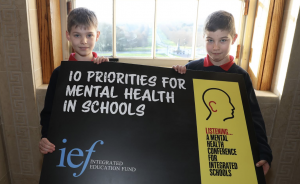
The event, which was funded through The National Lottery Community Fund, also served as a launch pad for Ten Priorities to be implemented to ensure mental health issues are addressed in schools.
The event was attended by representatives from integrated schools and political representatives.
The conference revealed that 79% of young people are too embarrassed or afraid to get support for their emotional well-being or mental health
It also highlighted that among some of the biggest issues impacting on young people’s mental health were school-related events including the Transfer Test, homework and other exams.
The findings were the conclusion of the day-long conference held at Drumlins Integrated Primary School in Ballynahinch. It was made possible by a collaboration of organisations including the IEF, Association of Principals & Teachers in Integrated Schools (APTIS) and Northern Ireland Council for Integrated Education (NICIE) while a support grant was donated by the National Lottery Community Fund.
The 154 participants came from 24 integrated schools from around Northern Ireland, making it the largest participative schools’ mental health conference in Ireland last year.
When asked the question ‘What are kid’s worries that cause tricky feelings to get stuck inside?’ a sample group of P6/7 children at the event identified the transfer test as by far their greatest stressor with school and homework also prioritised.
When asked who they would go to first if they felt in need of support with difficult emotions only 1% specified that they would currently approach a teacher or tutor with over 80% saying schools should help children to know and name their key support people in school.
Paul Collins, campaign fundraiser with the IEF, said the event will help form a plan that will address the issues impacting on the mental health of young people here, giving them the support they have asked for.
He said: “We want to highlight that mental health problems are prevalent but more importantly outline initiatives that can be put in place in an educational environment to support pupils.”
Grace Doherty, a Primary 7 student at Drumlins Integrated Primary School, Ballynahinch, participated in the conference in October. She said the conference made her realise how important mental health is, and how young people should to talk to friends and family when they are feeling down.
“It also made me understand how big a problem mental health is for young people in Northern Ireland and how there is not enough help for them. As a member of the Students Council in Drumlins IPS I know that even children in primary schools can suffer with their mental health too,” she added.
Conference participant, Freya Collins (11), from Lagan Integrated College added: “I believe that if teachers are trained to help poor mental health and parents are supported, we can work together to help improve wellbeing among many young people.”
The IEF’s Ten Priorities will aim to provide a support-based approach to mental health issues by focusing on training for education providers, access to health experts, delivery of mental health and emotional wellbeing through the curriculum, identifying young mental health ambassadors and establishing Gender Sexuality Alliance groups in the post primary setting, as well as creating programmes that connect with parents, among other things.
Alison Fraser, Head of Funding from The National Lottery Community Fund, which made the conference possible by awarding a grant of £10,000 said their experience of working with communities is that when they listen, young people, have amazing ideas to make things better.
“I am proud that funding raised by National Lottery players is being used to highlight mental health, such an important topic, and is helping to give young people the chance to form solutions with the Integrated Education Fund, so they can get the support that’s needed. Well done to everyone involved in this project, making a real difference to the lives of young people in Northern Ireland,” she added.